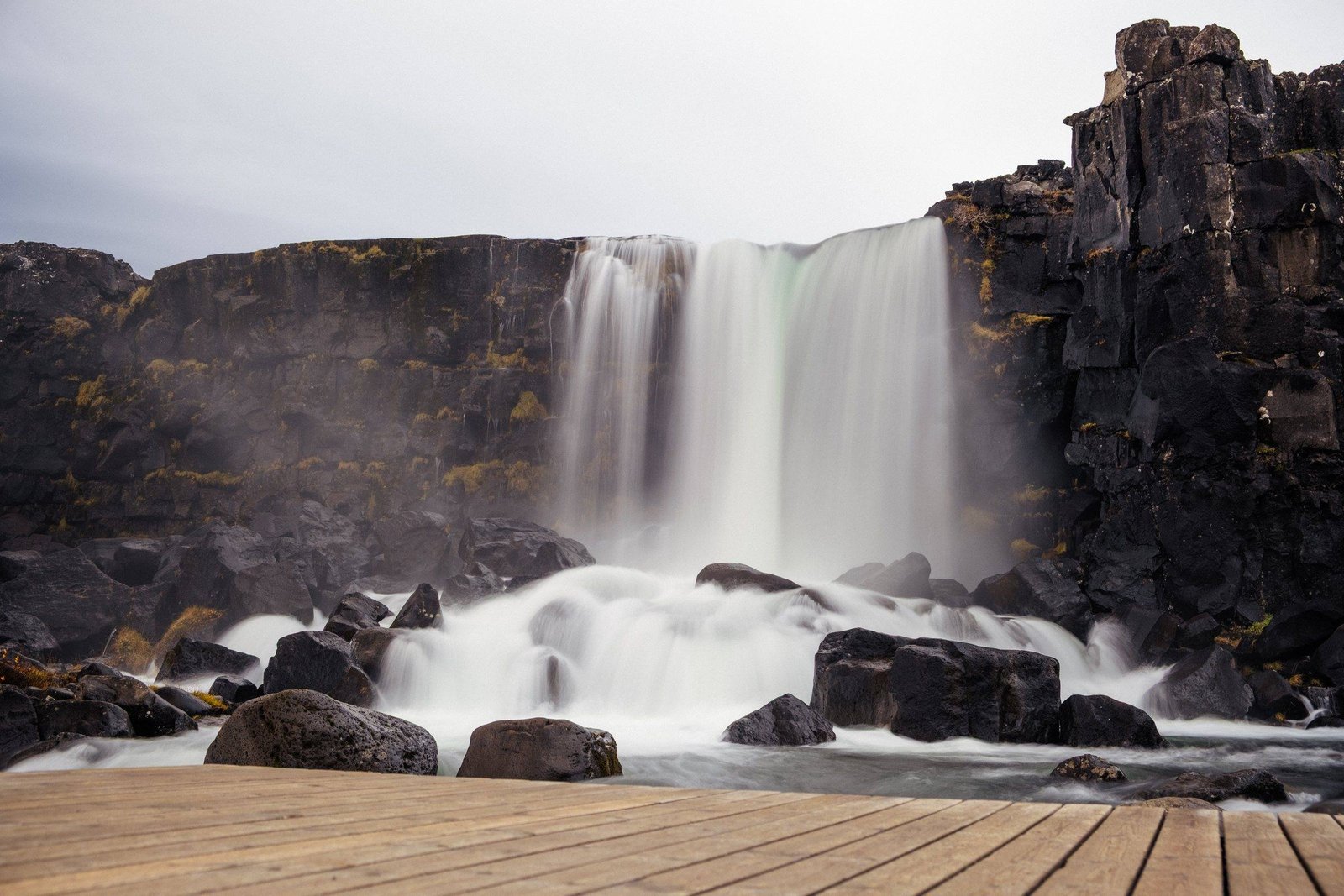

Feeling alone in Iceland: two men and a valley
At the end of a fjord in the Westfjords, in the same valley, two men lived alone. One built concrete lions. The other lived without electricity, and Iceland saw him on television on Christmas Day 1981.
by Aniello Iervolino 8 min read
They have wire whiskers. They are concrete lions, brightly coloured, set around a fountain, and they stand at the end of an Icelandic fjord, at the point where a gravel road runs out and after that there is the sea. They were built by a farmer who was about seventy, lived alone and had never studied art.
To reach him you have to cross a good deal of emptiness. In Iceland you can drive for half an hour without passing another car. The country is about a third the size of Italy, 103,000 square kilometres, and has fewer than four hundred thousand inhabitants: 394,324 on 1 January 2026, according to Iceland's statistics office. That makes fewer than four people per square kilometre, the lowest density in Europe. And about two Icelanders in three live in the Reykjavík area. Outside, there's mostly space.
While preparing our first photography expedition to Iceland, in October 2026, we looked for people in this country who had really lived solitude. We found the two strongest stories in the same place: a valley at the end of a fjord, Selárdalur.
That they ended up there doesn't surprise me. I've always been drawn to the outskirts of the world, forgotten places, people who live in a way completely different from mine. And I was born and raised in Calabria: a valley emptying out is a story that sounds familiar to me.
Selárdalur, where the road ends
The Westfjords are the most north-westerly peninsula of Iceland. Just over seven thousand people live there, scattered among long, narrow fjords. A century ago there were almost twice as many: in 1920 the inhabitants numbered 13,443, more than 14% of all Icelanders. Today they are less than 2%. Many roads, in winter, stay closed for months because of snow and ice.
One of these fjords is Arnarfjörður, which Icelanders also call the sea monster fjord. Here alone the recorded sightings number about a hundred and eighty, and in Bíldudalur, the nearest village, there's even a museum devoted to sea monsters, housed in the village's old food processing plant.
From Bíldudalur a road follows the coast westwards. It's the 619, Ketildalavegur: some twenty-five kilometres of gravel full of potholes. When it ends, you're in Selárdalur. A few houses, a church, the sea. The valley once had fifteen farms. The last farmer left in 2010.
What remains is two names everyone here knows.
Samúel, the artist with a child's heart
Samúel Jónsson was born in 1884 on the shores of Arnarfjörður and farmed all his life. His father died when he was four. His mother went into service at the Selárdalur rectory, and of that period he spoke of hardship and ill treatment. Then there were a wife, Salóme, and three children, all of whom died in childhood. In 1947, after twenty years spent in another fjord, husband and wife moved to the Brautarholt farm in Selárdalur. Salóme died shortly afterwards.
He had never studied art, but he had carried the urge to make it since he was a boy.
When he stopped working, in the early 1950s, he was about seventy. He lived alone. And he began.
First he painted an altarpiece and offered it to the valley's church, for its hundredth anniversary. The church already had one, old and valuable, and didn't want it. So Samúel built himself a church of his own, single-handed, to put his altarpiece in. It has a small domed turret right above the entrance.
Then came the concrete sculptures: people, animals, a statue of the explorer Leif Eriksson looking towards Vínland, the name the Vikings gave to America. A duck carrying her ducklings around. A man giving a fish to a tame seal. A blue seahorse, knee-high. And the fountain surrounded by colourful lions, a copy of the Fountain of the Lions at the Alhambra in Granada, in Spain.
What moves me is the order in which things happened. A man from whom life had taken almost everyone reaches the age at which people usually stop, and begins. The first thing he makes is a gift. They turn it down, and he answers by building a church around it.
Icelanders call him listamaðurinn með barnshjartað, the artist with a child's heart. In the writings on Icelandic art history, the museum that now bears his name points out, there is no trace of him. He died in 1969. After him the sculptures were left alone, to the wind and the frost, and began to crumble. The fountain stopped working. In 1998 an association was founded to save them, and since 2004 a group of volunteers, led by the German sculptor Gerhard König, has been restoring them summer after summer. König also got the fountain working again. Today it is considered the westernmost art environment in Europe.
Gísli, the man of Uppsalir
In the same valley, at the Uppsalir farm, lived Gísli Gíslason. He was born in 1907, on 29 October, and had three brothers. For decades he lived alone with his animals, with no electricity, no radio or newspapers, no haymaking machines. He kept a vegetable garden and grew strawberries. He owned an organ. He had very little contact with other people, and in the filmed interview that survives, Icelanders today struggle to understand the way he speaks.
The rest of Iceland discovered him in 1977, when the journalist Árni Johnsen interviewed him for the daily Morgunblaðið. But the moment that made him famous was another. On 25 December 1981, Christmas Day, Icelandic television broadcast an episode of Stiklur, Ómar Ragnarsson's travel series. It was called Börn náttúrunnar, the children of nature. It crossed the far west of the country, from Rauðasandur and Látrabjarg all the way to Selárdalur: Samúel's works and, at Uppsalir, Gísli.
A whole country, at Christmas, entered the home of a man who lived alone.
Not everyone took it well, and the gentler versions of this story usually skip that. According to his entry on Icelandic Wikipedia, many saw in Gísli a window onto the past. Others criticised the episode. Þorbjörn Broddason, professor of sociology at the University of Iceland, called it Ómar's worst misstep: it showed a fragile man in difficulty, and the fact that it had been so well liked seemed to him a bad sign.
I make documentaries too, and I can't read this criticism as a spectator. Walking with a camera into the home of someone who lives in a way very far from mine is one of the things that draw me most to this job. It's also the one where it's easiest to take something away without leaving anything.
Gísli, meanwhile, wrote verse. In 1987, a year after his death, a collection of poems and prose came out under the title Eintal, which in Icelandic means monologue. A Westfjords guide quotes four rhyming lines of his about the fjord's monsters, which are also a piece of advice: if you meet one, don't be afraid, because being afraid would only make things worse. Greet it politely and keep walking.
Gísli died on 31 December 1986, the last day of the year. Today Uppsalir belongs to the Icelandic state, and his house has become a small museum. An association of friends has put it back in order, bringing in running water, electricity and a kitchen. The opening was on 7 August 2026, during the valley's festival. The programme included a speech by the Minister of Culture, an actor to read Gísli's poems and reflections, a musician to play his organ.
It gives me a strange feeling to know that in the house of the man without electricity there is now power. Then I think that the alternative was to let it fall down, as was happening to the lions.
The children of nature, ten years later
That title, Börn náttúrunnar, came back in Iceland. In 1991 the director Friðrik Þór Friðriksson gave it to a film. An old farmer ends up in a retirement home in Reykjavík, finds there a woman he had loved when he was young, and together they steal a jeep and flee towards Hornstrandir, in the far north-west, because she wants to be buried in the abandoned village where she was born. It is still the only Icelandic film ever nominated for the Oscar for best foreign language film.
One of the best-known characters in Icelandic literature is also a man who wants to be left to himself. His name is Bjartur, he raises sheep, and in Independent People by Halldór Laxness, published in two parts in 1934 and 1935, he works as a shepherd for others for eighteen years before managing to make the first payment on an isolated farm of his own. Laxness won the Nobel Prize in 1955, "for his vivid epic power, which has renewed the great narrative art of Iceland."
A country that recognises itself in a stubborn sheep farmer and in two old people fleeing towards an empty village has a relationship with solitude that is hard to grasp from outside. Samúel and Gísli, seen from here, look less like exceptions.
Two words for being alone
In the listing for that Stiklur episode, Gísli is called einbúinn: the man who lives alone. It's a description and nothing more. For loneliness that weighs on you, the kind that hurts, Icelandic has another word: einmanaleiki, which comes from einmana, alone in the sense of someone who feels lonely.
In Italian we have one word for both things, solitudine, and every time we have to explain which one we mean.
About Samúel, we don't know whether he also felt the second, and we don't want to guess. About Gísli something is known. The same Icelandic entry says it isn't clear whether he withdrew by himself or was pushed to the margins for being different, and that he was often lonely and not content with his circumstances. It's a single line, and it changes the way you look at that Christmas episode.
We also know what they left behind. One, a fountain of colourful lions at the end of a fjord. The other, a house without electricity that a whole country wanted to see.
And us
Selárdalur wasn't on the route of the October expedition, which followed the Ring Road. The question remains, though: what it means to feel alone in a place so big and so empty.
If you get there before us: Selárdalur is reached from Bíldudalur, following the coast of Arnarfjörður westwards along the 619. At Samúel's museum, at Brautarholt, the reception and the café are open from June to August, and next to it there's a marked camping area. In winter always check the state of the roads on road.is, which now redirects to umferdin.is; for traffic information there's also a telephone number, 1777. And if you go, write to us.
To understand the country better, read also 10 strange things about Iceland and the elves that make roads bend.
sources
- A visit to Arnarfjörður in the Westfjords, Guide to Iceland
- Stiklur, episode «Börn náttúrunnar» (25 December 1981), TheTVDB
- Samúel Jónsson, SPACES Archives
- Samúel Jónsson and Selárdalur, The Reykjavík Grapevine
- Gísli á Uppsölum, Wikidata
- Westfjords, Wikipedia
- Samúel Jónsson's Art Museum (biography), nat.is
- Listasafn Samúels, website of the Samúel Jónsson museum
- Gísli á Uppsölum, Icelandic Wikipedia
- Selárdalshátíð, opening of the museum at Uppsalir (7 August 2026), Visit Westfjords
- Children of Nature (Börn náttúrunnar, 1991) by Friðrik Þór Friðriksson, Wikipedia
- Independent People (Sjálfstætt fólk, 1934-1935) by Halldór Laxness, Wikipedia
- Halldór Laxness, Wikipedia
- Population 1 January 2026, Statistics Iceland (12 March 2026)
- Iceland, Wikipedia
- Capital Region (Iceland), Wikipedia
- einmanaleiki, Wiktionary
- eintal, Wiktionary
- Umferdin.is, traffic and road information in Iceland