"If you win, you must say goodbye to the horse the next morning": why Icelandic horses never come back
An Icelandic horse that leaves the island can never come back, not even after a competition. Behind this rule lie a thousand years of isolation, a saga, a winter of poisonous haze and riders who say goodbye to their horses the morning after they win.
by Aniello Iervolino 7 min read
"If you win, you must say goodbye to the horse the next morning."
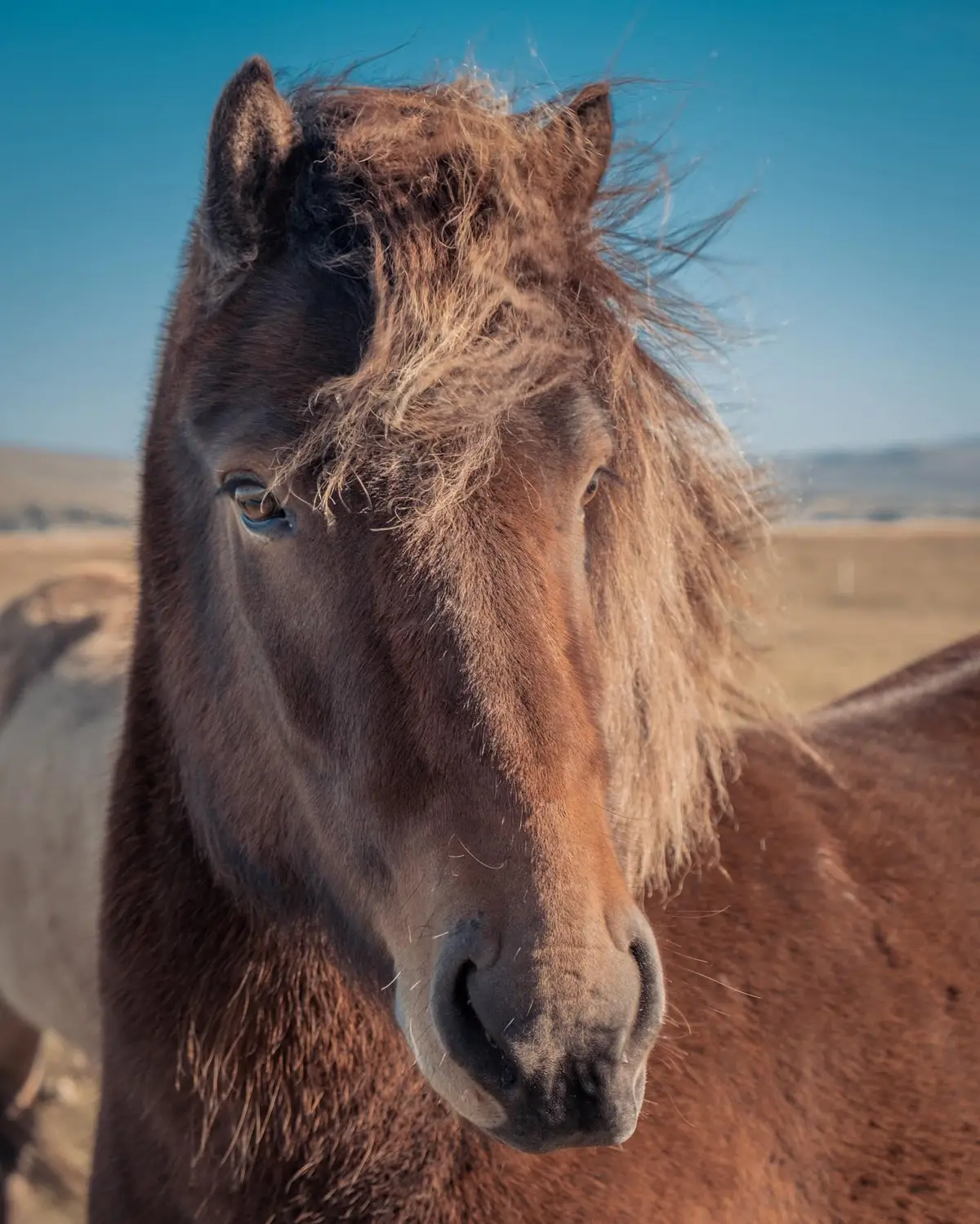
Védís Huld Sigurðardóttir says it. With her sister Glódís Rún she rides competition horses at Sunnuhvoll, a stable three quarters of an hour from Reykjavík. The sentence comes from an interview published in May 2024, and it should be taken literally. When an Icelandic horse goes abroad to compete, it can never come back. If it wins a championship abroad, it stays abroad, and it is sold there.
The sisters explain that a competition horse stays with them for about three years, and that they choose carefully who buys them, because they do not want just anyone to have them. Védís admits she forms a strong bond with her horses, "maybe too close sometimes because it can be difficult for me to sell them". Glódís adds something I did not expect to read in a piece about sport: loneliness, she says, makes you even more attached to the horses, and makes it even harder when they have to be sold.
I started here because this rule, seen from outside, looks like a postcard curiosity. Seen from a stable, it is a parting.
A one-way ticket
The rules are in black and white. Under Icelandic law horses cannot be imported, and those that leave do not come back, including the ones that go to international competitions. The Icelandic veterinary authority, Matvælastofnun, writes that hundreds of horses are exported every year, mostly to countries in the European Union, aged between four months and fifteen years, each with its own passport. About 80,000 live in Iceland. Abroad there are about 100,000, and almost 50,000 of them are in Germany.
The reason is health. Icelandic horses are not vaccinated, the same authority explains, and so they are exposed to any disease that arrives from outside. A population isolated for so long has few defences. That is why the rule applies to things too: you cannot bring used riding equipment into Iceland, no saddles, no bridles, no gloves.
982, perhaps
Everyone tells the origin of this isolation the same way. The horses came from Norway with the settlers, in the ninth and tenth centuries, and for centuries they were the only way to cross the island. Then, in 982, the Alþingi, the assembly at Þingvellir, is said to have banned importing any more. The date can be found on Wikipedia and in many guides.
Gísli B. Björnsson and Hjalti Jón Sveinsson, authors of a book of more than four hundred pages on the Icelandic horse, are more cautious. As far as is known, they write in a passage quoted by an enthusiasts' blog, importing horses into Iceland was not forbidden until 1882, and there are no sources to confirm the belief in a medieval ban. The blog adds a simpler explanation: for centuries nobody brought new ones in because there was no need, and because after the thirteenth century ships between Iceland and Europe became rare.
I prefer this version. The isolation that made this breed came from the sea and from centuries of scarce traffic, and only much later did someone put it in writing.
Freyfaxi
In the sagas a horse says who you are. Owning them, breeding them, knowing how to ride them was a sign of wealth and standing, the Perlan museum notes. In the Commonwealth period there were even stallion fights, for entertainment and to choose breeding animals.
The hardest horse story I know comes from the east. In Hrafnkels saga, probably written around 1300, the chieftain Hrafnkell dedicates his favourite horse, Freyfaxi, to the god Freyr, and swears to kill anyone who rides him without his permission. One day his shepherd, Einar, needs a horse. They all run from him, except one: Freyfaxi. Einar rides him for a single day. The horse comes home sweaty and dirty, and Hrafnkell, reluctantly, kills the shepherd to keep his oath. Later, his enemies take Freyfaxi to a cliff and push him off.
It is a story that stays with me, because nobody is entirely to blame. There is a man trapped by his own word, a shepherd who took the only horse that would let itself be caught, and an animal that pays for both of them. When his enemies burn his temple as well, Hrafnkell says that believing in gods is folly, and he never sacrifices again.
The gods rode horses too, after all. Odin had Sleipnir, who had eight legs. According to Icelandic folklore the horseshoe-shaped canyon of Ásbyrgi, in the north, is the print of his hoof.
The winter of the haze
The moment this breed came closest to disaster arrived from a volcano.
On 8 June 1783 the Laki fissures opened, in the south, and for eight months they poured out lava and gas. Icelanders call what followed Móðuharðindin, the mist hardships. Fluorine settled on the grass, and the animals that ate it fell ill in their bones and teeth. About 80% of the sheep died, half the cattle and half the horses, about 28,000. In the famine that followed at least one Icelander in five died.
Of that winter I only have numbers, and I would rather not add anything to them. In a country where for centuries the horse had been the only way to cross the island, one in two disappeared. Today's horses descend from the ones that remained.
The gait that does not jolt
What made these horses famous is the tölt, a four-beat gait in which at least one hoof is always on the ground, which makes it very comfortable to ride. As well as walk, trot and canter, many Icelandic horses have the tölt, and some also the skeið, the flying pace, a two-beat lateral gait used over short distances in which the fastest reach about 48 km/h. Those with all five gaits are the most prized.
They are small, between 132 and 142 centimetres at the withers, but to Icelanders they are horses, and their language has no word for pony. They come in more than forty recognised colours and up to a hundred variations, and Icelandic has more than a hundred names for coat colours and patterns.
When they come down from the mountains
In summer, in the north, many herds spend about three months roaming free in mountain valleys, the afréttur. They are the only domestic animals in Iceland that live outdoors all year round: with a double coat and the fat stored up in summer, if they have good grazing and shelter they reach spring in good shape even without extra feed.
At the end of September the farmers ride up to bring them back. The biggest round-up is called Laufskálarétt, in the Hjaltadalur valley, in Skagafjörður: about 500 horses and between 2,000 and 3,000 people. The horses enter a round pen and are sorted into each farm's small pens. Many farmers recognise them by sight, even though today they are microchipped. Then nearly all of them lead the horses home on foot, as a loose herd, along the road. Horses of Iceland warns drivers to be ready for small traffic jams caused by Icelandic cowboys.
There is a summer gathering too, the Landsmót, the great national horse show. It has been held since 1950, and in its early years, Iceland Review reported, everyone rode there, all the way to Þingvellir. In 2026 it was at Hólar, in Skagafjörður, from 5 to 11 July.
The October horses
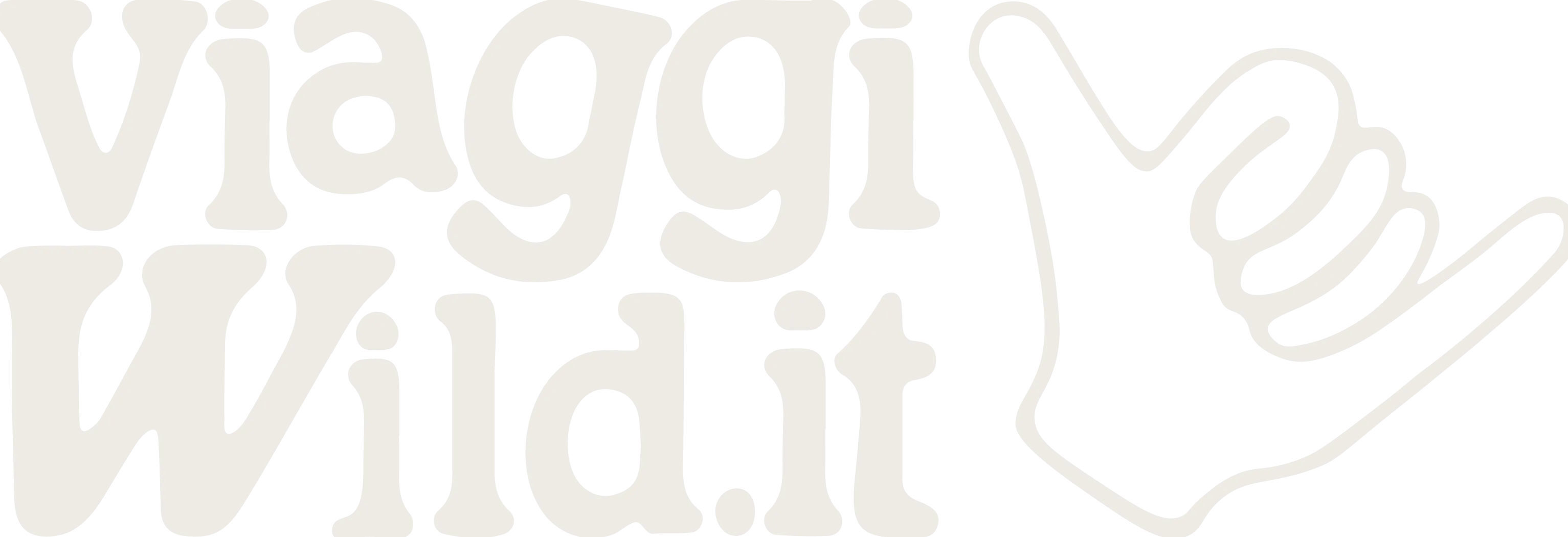
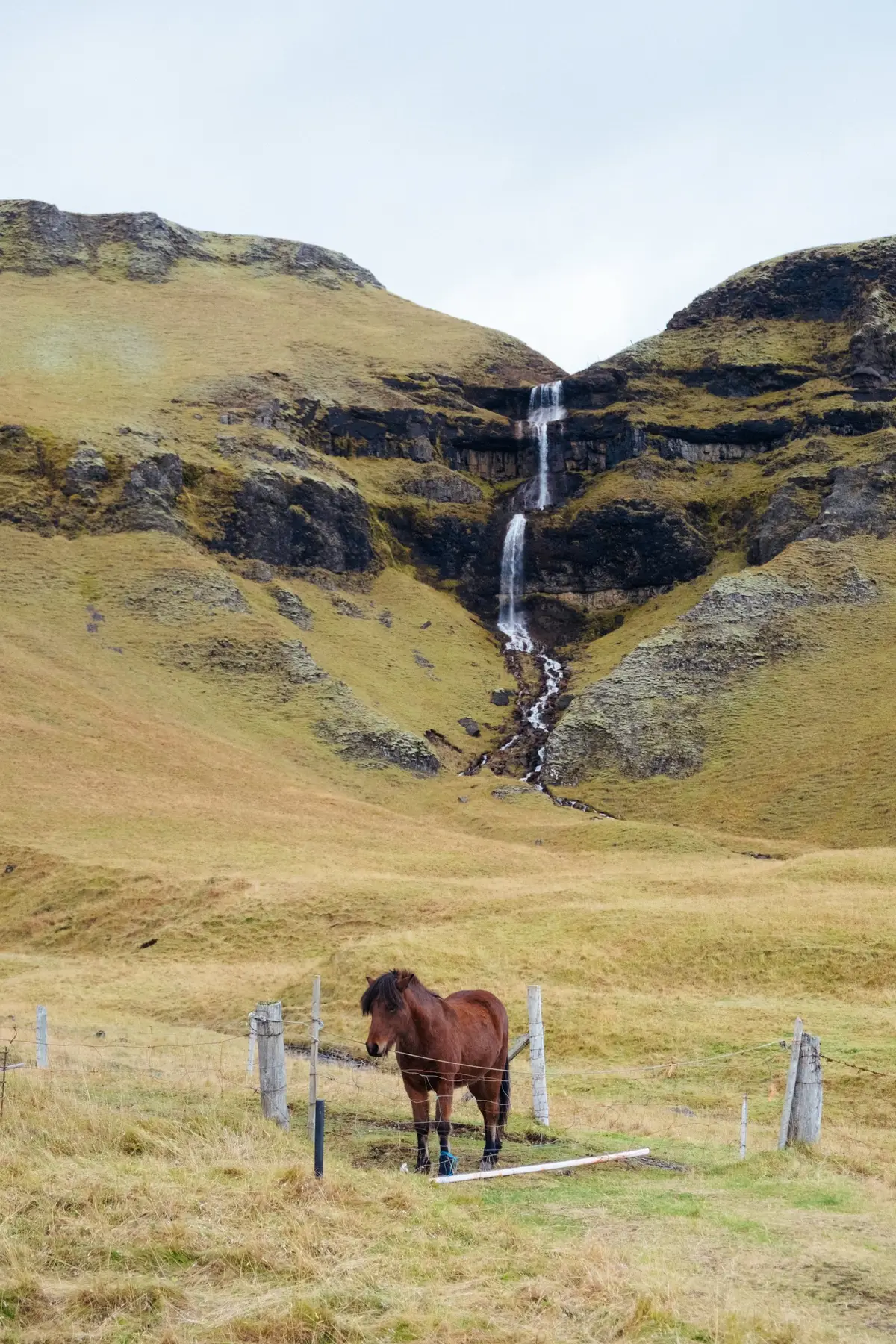
We took two of the photos in this article in October 2026, along the road. The cover shows a chestnut horse with a long pale mane walking along a wire fence. Behind it a thin waterfall comes down a dark rock face, with a red barn and a few fir trees. In the other a brown horse stands still on its side of the fence, looking at us, with another waterfall dropping in two steps behind it.
Looking at them again I think of Védís. That horse was born on this island, and it will almost certainly die here. If one day it leaves, it will be for good, and someone, one morning, will say goodbye to it.
How to greet them
One practical point, because you meet horses along the road and the temptation to stop is strong. The Perlan museum asks you not to feed them, because bread and snacks upset their digestion, never to enter fields without the owner's permission, to let the horse come to you and not to touch its face. To look at them you stop in lay-bys, never in the middle of the road. And if you want to ride in Iceland, Matvælastofnun asks you to machine-wash clothes used around other horses; boots, helmets and anything that cannot be washed must be cleaned, dried, sprayed with disinfectant and left for at least five days before going near an Icelandic horse.
To understand the island that raised them better, read 10 strange things about Iceland and when to go to Iceland, which also covers the September sheep round-ups. The Laki eruption and the moss that has covered its lava are in the story of Iceland's lava fields.
sources
- Icelandic sisters at the top: "You have to be mentally strong to do this every day", Caecilie Kallehave Jensen, Malgré Tout, 30 May 2024
- Icelandic horses, Perlan museum, Reykjavík
- The Icelandic Horse, Man's Most Hardworking Friend, Þórunn Arnaldsdóttir, Iceland Review, 21 March 2024
- Icelandic horse, Wikipedia
- Export of animals, Matvælastofnun (Icelandic Food and Veterinary Authority)
- Import of riding equipment, Matvælastofnun (Icelandic Food and Veterinary Authority)
- No law banning import of horses to Iceland until 1882, quoting Gísli B. Björnsson and Hjalti Jón Sveinsson, The Icelandic Horse, Blessi blog, 23 February 2015
- Hrafnkels saga, Wikipedia
- Sleipnir, Wikipedia
- Laki, Wikipedia
- Upkeep in Iceland, Horses of Iceland
- Horse trip and round-up, Horses of Iceland, 2 October 2022
- Über den Kjölurpass zum Landsmót, Iceland Review, 25 June 2014
- Landsmót Hestamanna in Hólar, press release May 2026, FEIF