
He had lost his son in the fire, she her husband: Jökulsárlón and the land the ice took
On the Breiðamerkursandur plain, where a saga sets the end of Kári's revenge, the ice swallowed the farms and then drew back. In its place, since 1934, there is a lagoon 284 metres deep that keeps on growing.
by Aniello Iervolino 8 min read
In Njál's saga there is a night of fire. A group of men led by Flosi Þórðarson burns the farm at Bergþórshvoll, and inside die Njáll, his family and also Þórður, the son of Kári Sölmundarson. Of the blood brothers, Kári is the only one who escapes.
The saga goes on for a long time, and at the end it does something you do not expect. Kári and Flosi make peace. Kári marries Hildigunnur, Flosi's stepdaughter, the widow of Höskuldur, the man Njáll's sons had killed after listening to slander. The man who lost his son in the fire and the woman who lost her husband at the hands of his family go to live together, on the banks of the river Breiðá, on the Breiðamerkursandur plain, in the south-east.
Today that plain is black sand, moraines and water. In the middle of it lies Jökulsárlón, the iceberg lagoon.
The land the ice took
The Book of Settlements says that the plain was inhabited from the first years of the colonisation, nearly 1,100 years ago. Ari the Wise, in the Book of Icelanders, writes that back then a forest stretched from the sea to the mountains. It is a sentence that hits hard in front of this landscape of sand and stones.
Then, from the thirteenth century, the climate changed. It grew colder, and the glacier tongues began to come down. The texts of the Breiðármörk trail map, written by Snævarr Guðmundsson of the South East Iceland Nature Center and Vala Garðarsdóttir of the Hornafjörður Museums, set out what is known. In 1387 the farm at Breiðá appears under the name Breiðármörk. In 1523 it belongs to the episcopal seat of Skálholt. By 1698 the land is considered deserted. The oldest farms, they write, were swallowed by the glacier or washed away by glacial rivers. Exactly where Kári and Hildigunnur's farm stood is not known, and the riverbed has shifted too many times to hope to find its remains.
Breiðamerkurjökull kept advancing through the eighteenth and nineteenth centuries. Around 1890 its front was 250 metres from the sea.
That number stays with me. A glacier coming down from an ice cap the size of a region and stopping a couple of blocks from the ocean. In between, a narrow strip where people kept on passing through.
The ones who stayed
The easternmost farm of Öræfi, right on the edge of the plain, is called Kvísker. It lies to the west of Breiðamerkursandur, with Öræfajökull behind it and the sand in front, more often than not surrounded, writes the Icelandic government, by untamed glacial rivers. For centuries the people of Kvísker had an extra duty: when the rivers were too swollen to ford, they took travellers across the plain or over the glacier tongue.
In the twentieth century nine siblings grew up at Kvísker, the children of Björn Pálsson and Þrúður Aradóttir. They studied almost entirely at home, with no higher education, and became known all over Iceland for what they knew about nature. Flosi devoted himself to glaciers and natural science and taught himself several foreign languages, with dictionaries and radio courses, so he could talk to the scholars who came by. Hálfdán built up the largest private insect collection in the country. Páll founded the Öræfi search and rescue team.
And then there is Sigurður, who wrote the history of Öræfi and who one day, on the glacier, fell head first into a crevasse. He was stuck down there and began to sing hymns. His voice reached the ears of the people searching for him, and after many hours of searching they found him. He died in 2008, at ninety.
I think of him when I read how young this lagoon is. The Kvísker family knew the ice when it was still close to the sea, and lived long enough to see it go.
A ninety-year-old lagoon
The retreat began at the start of the twentieth century. The lake in front of the glacier took shape around 1934. It has not stopped growing since: about 8 square kilometres in 1975, about 25 today. At its deepest point it reaches 284 metres, and so it is considered the deepest lake in Iceland. The glacier front, which a century and a half ago was 250 metres from the sea, is now about eight kilometres away. By 2010, the Breiðármörk texts calculate, the plain uncovered by the ice had grown by about 86 square kilometres compared with 1900.
The lagoon empties into the ocean through a river, the Jökulsá, which today is about 500 metres long. Before the Ring Road bridge was built in 1967, the crossing was so dangerous that many people preferred to go over the glacier tongue; from 1932 there was also a boat. Now the problem is the sea: between 1904 and 2003, according to the Icelandic Road Administration, the coast near the bridge retreated about 770 metres, eight a year. If the sand spits gave way, the lagoon would become a fjord.
Come to think of it, the lagoon is younger than the Kvísker siblings: Flosi was born in 1906, and it began to form almost thirty years later. The Breiðármörk texts say it with a gentleness I did not expect: living here was hard, and in return nature gave Iceland one of its greatest treasures.
Ice turned film set
The first boat tours began in 1985, the same year as A View to a Kill, the Bond film that used the lagoon as a set. In the summer of 1987 there were about 5,000 passengers. Today the company carries between 60,000 and 70,000 a year.
In 2002 James Bond came back, with Die Another Day. To film the car chase on the ice the production built a temporary dam at the mouth of the channel, so that salt water from the sea could not get in and the lagoon could freeze. Four Aston Martins and four Jaguars, converted to four-wheel drive, were used and wrecked. It makes me smile that for a film they had to shut the sea out of the lagoon. For ninety years it has been the glacier deciding what shape this place has.
In 2017 the Icelandic state bought the farm of Fell, on which the lagoon lies, and that same year the plain became part of Vatnajökull National Park. Since 2019 the park has been a UNESCO World Heritage Site.
25 August 2024
The glacier that feeds the lagoon also has a cost, and it should be told with respect. On Sunday 25 August 2024, on Breiðamerkurjökull, an ice cave partly collapsed while a group of about 25 tourists was there with a guide. Four people were hit by ice. One person died at the scene, another was flown by helicopter to hospital in the capital. Rescuers worked until dark, cutting the ice almost entirely by hand, with chainsaws.
It was summer. After that accident the park tightened its rules: today the caves can only be visited from October to April, with companies that hold a contract, assess the risks every day and share information with each other. Each guide may take between 8 and 16 people. The park's chairman, Sigurjón Andrésson, told the Grapevine that those contracts must not become something that can be bought and sold.
I do not know the name of the person who died that day and I am not looking for it. I know they were there to see the ice from the inside, like so many others, and that ice moves even when it looks still.
The October photographs
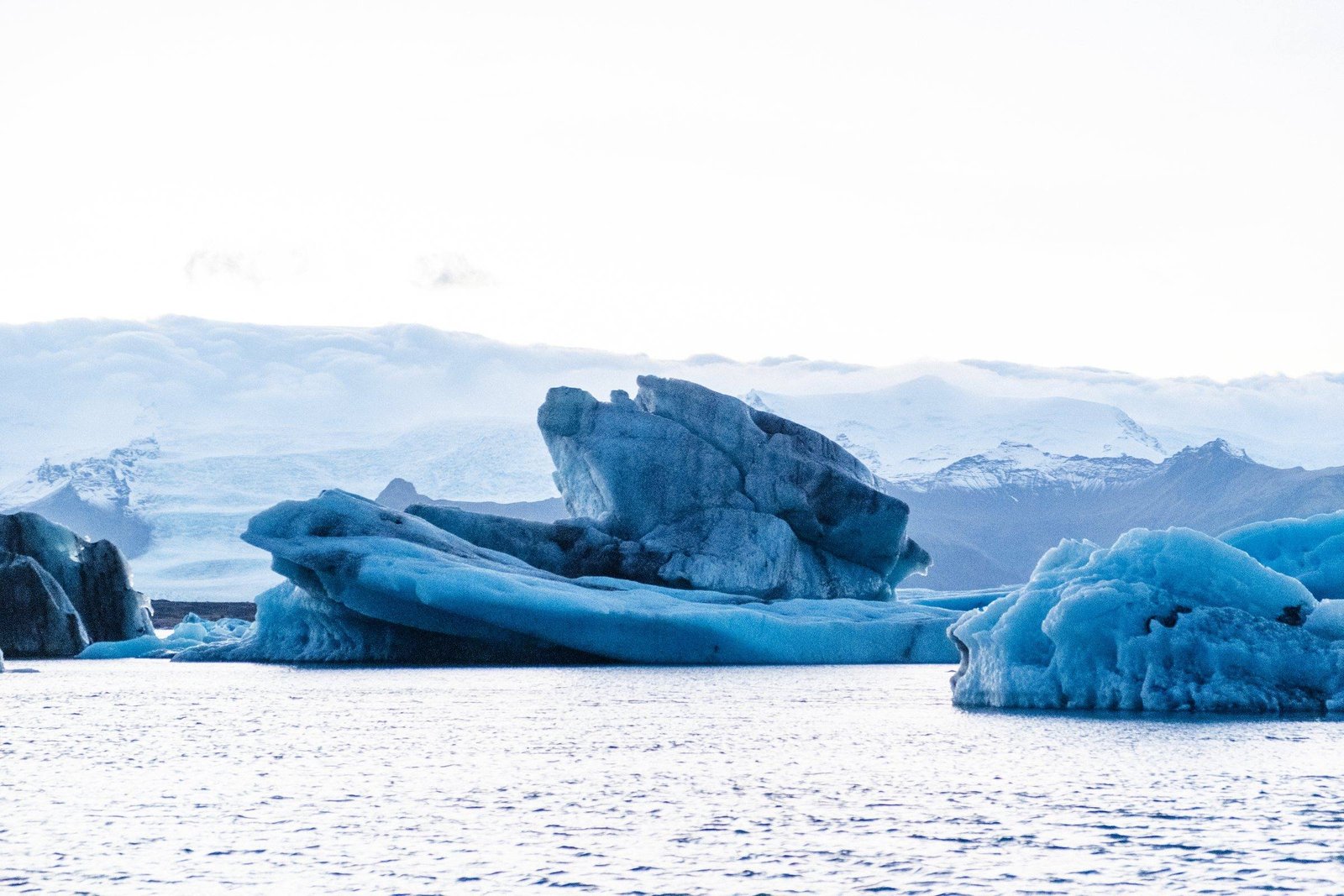
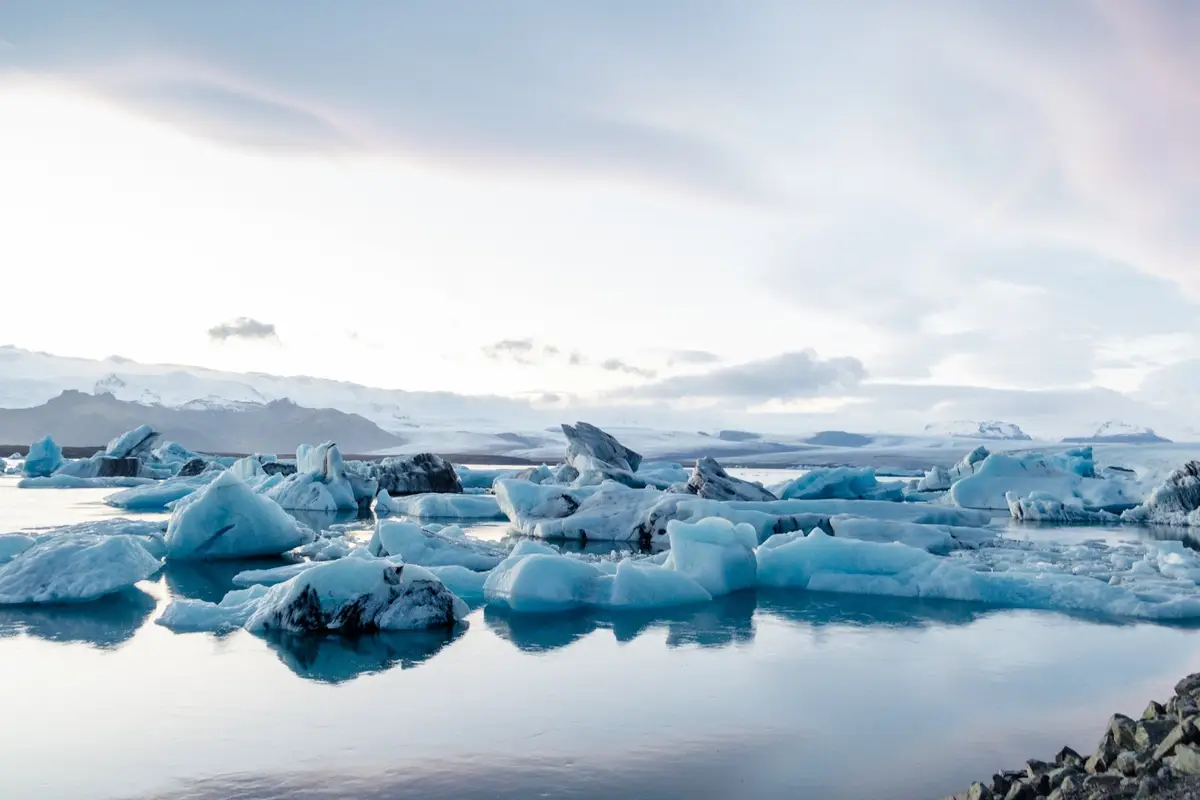
We passed through Jökulsárlón in October 2026, and we took the photos of the lagoon there. The cover shows a large blue and grey iceberg, streaked with dark lines, with the mountains and the glacier half hidden by cloud behind it. In the other the lagoon is still as glass and the icebergs are mirrored in it, under a faintly pink sky.
Looking at them I think that every block of that ice broke off the glacier not long ago, and that sooner or later it will turn back into water, in the lagoon, in the sea or on the beach across the road. It is also the reason this place is photographed so much: it keeps changing.
If you go
Jökulsárlón is on the Ring Road, and it is open all year. In November 2026 parking in the park costs 1,110 krónur for a car with up to five seats: the ticket is valid until midnight, and if you have already paid at another area of the park that day you pay half. Boat tours depend on the weather and the ice: according to the company, the Zodiacs go out from May to October, the amphibian boats from May to mid-November.
In winter seals gather at the mouth of the lagoon to fish, and sometimes rest on the ice. You never climb onto the icebergs, though. Visit South Iceland says it clearly: floating ice can roll over or break apart without warning. Across the road is Fellsfjara, the beach everyone calls Diamond Beach, where ice from the lagoon is stranded on the black sand: the park asks you not to walk over the bridge but to go under it. It is the same open ocean as the rest of the south coast, and the Reynisfjara rule applies there too: never turn your back on the sea. If you want fewer people, to the west there is Fjallsárlón, another lagoon in front of another glacier, linked to Jökulsárlón by a trail of about 15 kilometres.
The story of the people who measure Iceland's retreating glaciers, and of the first Icelandic glacier declared dead, is in a letter to the future. On the same coast, before you get here, you pass Reynisfjara and its waves. And to fit the lagoon into a trip there is the photographic itinerary on the Ring Road.
Questions and answers
How much does parking at Jökulsárlón cost?
In November 2026 Vatnajökull National Park charges 1,110 krónur for a car with up to five seats. The ticket is valid until midnight, and if you have already paid at another area of the park the same day you pay half.
When do the boat tours run at Jökulsárlón?
According to the company that runs them, the Zodiacs go out from May to October and the amphibian boats from May to November, always depending on the weather and the ice.
Can you climb onto the icebergs in the lagoon?
No. Visit South Iceland warns never to step onto floating ice: the blocks can roll over or break apart without warning.
sources
- Breiðármörk, trail map between Jökulsárlón and Fjallsárlón, The Realm of Vatnajökull, texts by Snævarr Guðmundsson and Vala Garðarsdóttir, 2014
- Kvísker, Kvískerjasjóður, Government of Iceland
- Kvísker, nat.is
- Breiðamerkursandur, Vatnajökull National Park
- Jökulsárlón, Wikipedia
- Jökulsá (Breiðamerkursandur), Wikipedia
- Coastal erosion and coastal protection near the bridge across Jökulsá river, Breiðamerkursandur, Iceland, Helgi Jóhannesson and Sigurður Sigurðarson, Vegagerðin, January 2006
- Die Another Day (2002), Wikipedia
- Glacier Lagoon, website of the boat tour company, accessed November 2026
- Tourist dies in Iceland glacier collapse, Euronews, 26 August 2024
- Visitor numbers may be limited on Vatnajökull ice cave tours, The Reykjavík Grapevine, 16 September 2025
- Price list, Vatnajökull National Park, accessed November 2026
- Fellsfjara, Vatnajökull National Park
- Jökulsárlón Glacier lagoon, Visit South Iceland