
She waded rivers to save Gullfoss: Sigríður and Iceland's Golden Circle
A farmer's daughter who waded rivers to save Gullfoss, a film director who gave Geysir to the Icelanders, a crater with a gate, a tomato greenhouse and a bishop who, before dying, answered "I know". Iceland's most famous loop told through the people who lived along it.
by Aniello Iervolino 9 min read

To get to Reykjavík from her farm, Sigríður Tómasdóttir had to wade large rivers. She did it in every season, on foot or on horseback, over mountain roads, to go and speak to officials in the capital. She was born in 1871 at Brattholt, a sheep farm beside a waterfall, and the waterfall was Gullfoss.
Today Gullfoss is one of the three main stops on a loop of about 230 to 250 kilometres that starts and ends in Reykjavík. The name Golden Circle was invented by the Icelandic tourism board to promote travel to the country, and the loop takes in some of the most visited places on the island: Þingvellir, the geysers of Haukadalur, Gullfoss. Often the Kerið crater and the bishop's seat at Skálholt are added. I tried to follow it through the people who lived along it, and in the end the one who stayed with me most is Sigríður.
The first place on the loop
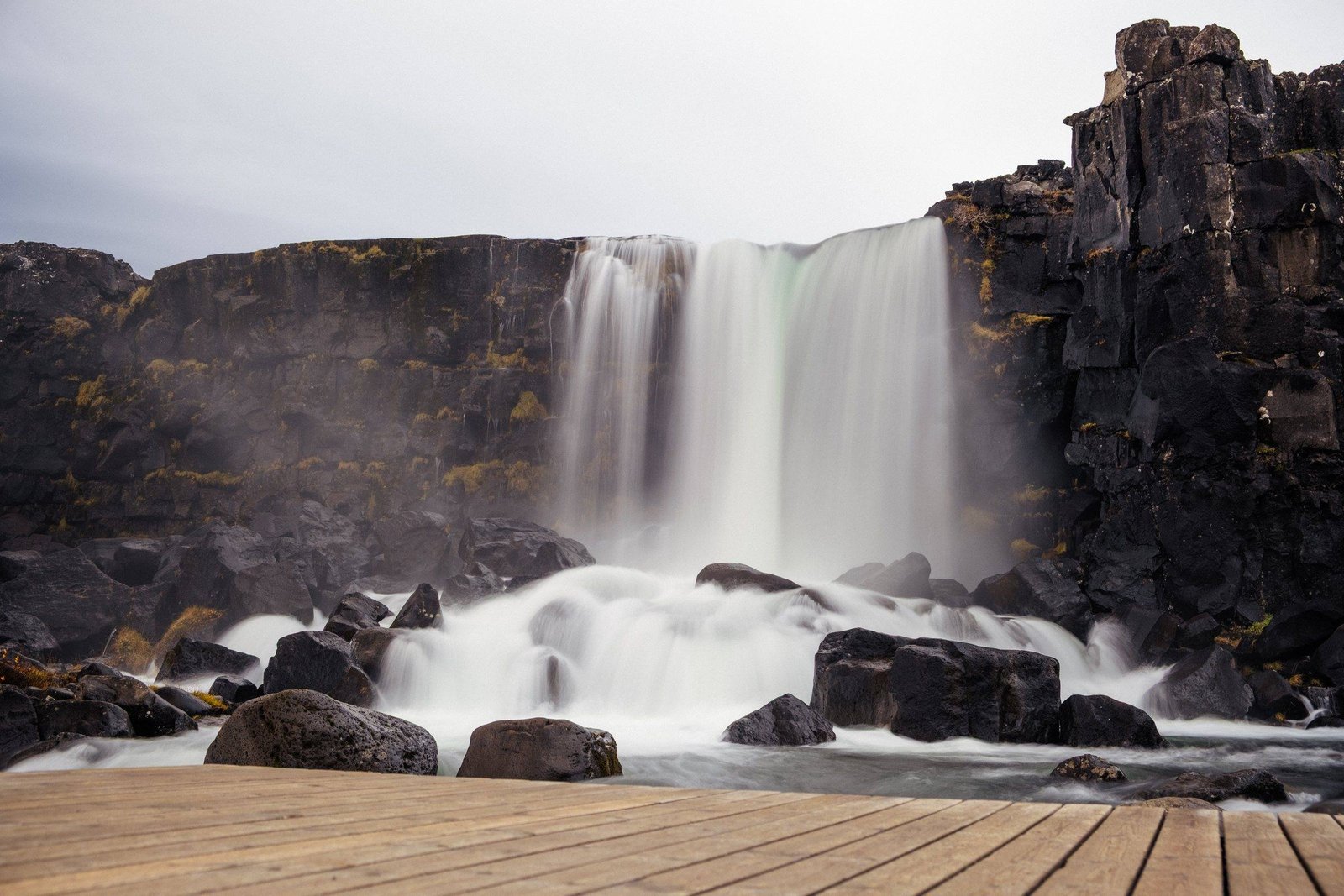
The loop almost always begins at Þingvellir, in the valley where Iceland's parliament met for almost nine centuries and where the republic was born in 1944. I have written a separate piece on the valley and its voices. Here only one name matters, because it will come back: Sveinn Björnsson, the man who on that rainy day became Iceland's first president.
A waterfall for rent
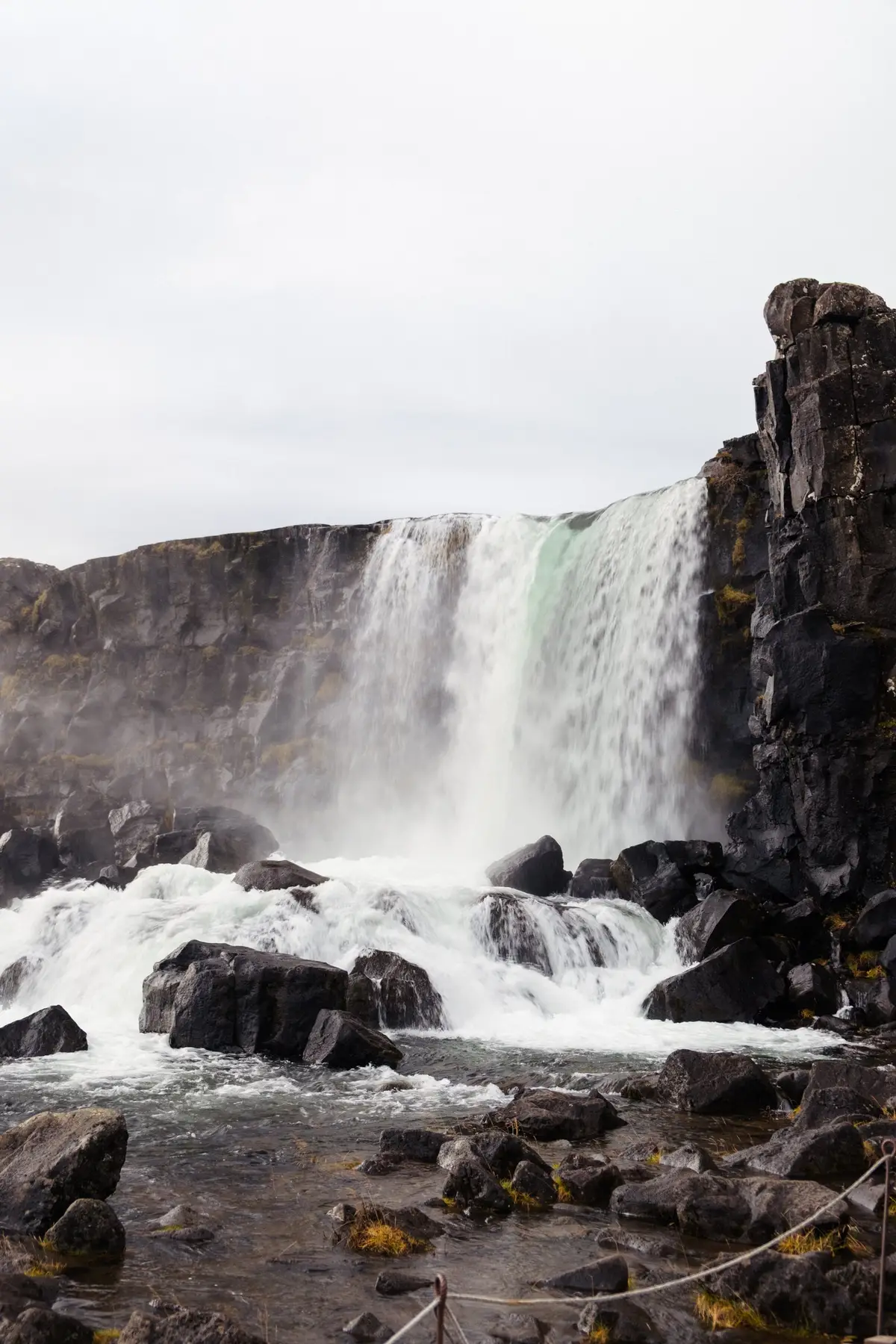
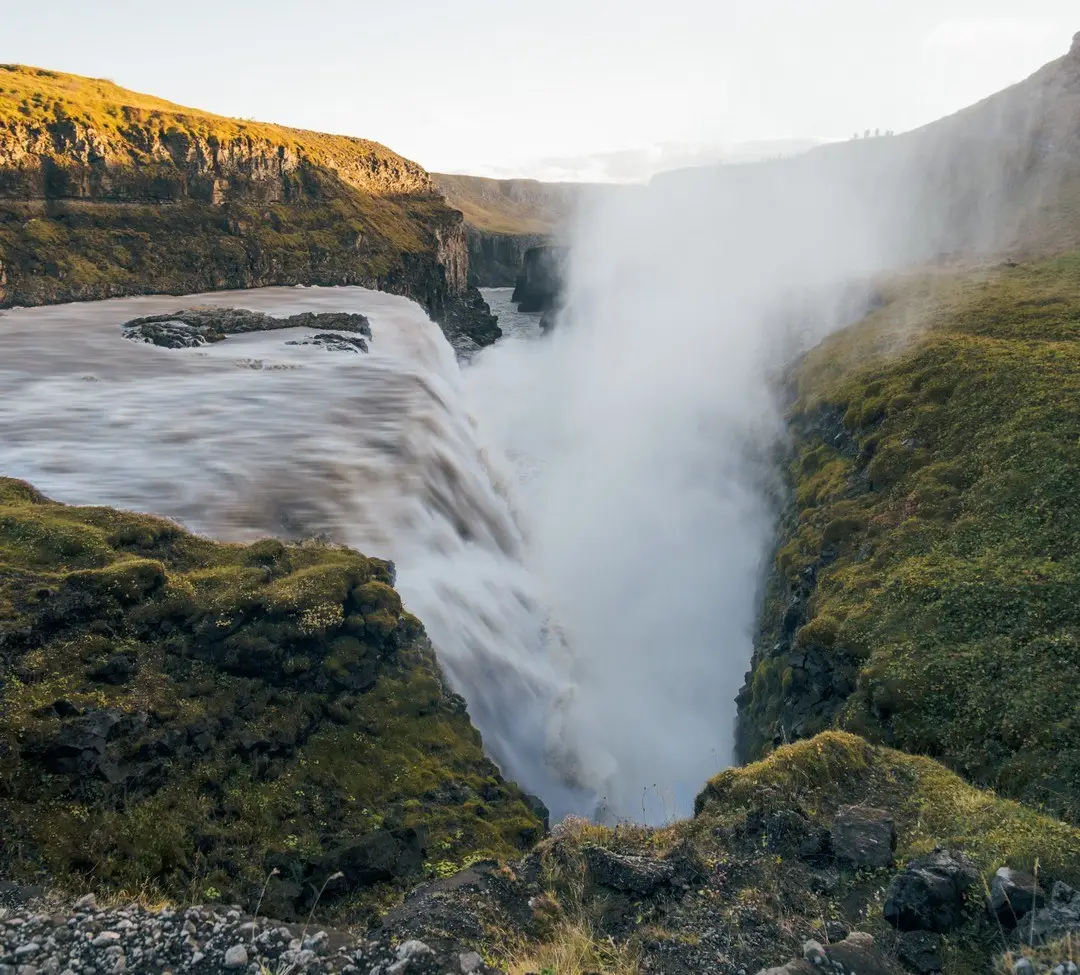
Gullfoss falls in two steps, one of 11 metres and one of 21, into a crevice 32 metres deep and two and a half kilometres long. In summer an average of 141 cubic metres of water pass every second, in winter 80. It is the river Hvítá. The waterfall belonged to the owners of the land on the two banks: one was Tómas Tómasson, Sigríður's father, the other, according to Wikipedia, Halldór Halldórsson.
Sigríður had no schooling. Wikipedia remembers her as a woman who was well read and artistic, and says that with her sisters she guided visitors to the falls. Long before there was a Golden Circle, the guides here were the girls from a farm.
In early 1907, according to the Environment Agency of Iceland, an Englishman offered 50,000 krónur to buy Gullfoss. There was talk of using the waterfall to produce electricity. That same year Iceland passed a law allowing only people and companies domiciled in the country to own waterfalls, unless special permits were granted. It was not enough: the Agency writes that many large waterfalls still ended up in the hands of unscrupulous buyers. Gullfoss was leased, through intermediaries, to foreign investors, and Sigríður's father was among the owners who signed.
That is when her journeys began. It is about a hundred and twenty kilometres from Brattholt to the capital, and she made the trip many times, on foot by some accounts. She asked a lawyer for help, and the lawyer was Sveinn Björnsson. In a recollection quoted by the Environment Agency, Sveinn says that this woman came to him for legal advice: she wanted the contracts annulled.
She lost. The case went nowhere. It is also said that she threatened to throw herself into the waterfall, and Wikipedia, in its Gullfoss entry, carefully writes "reportedly". What is certain is how it ended. The investors' attempts failed, partly for lack of money; in 1928 the rent stopped being paid and the agreement became void. In 1945 the state bought Gullfoss from the owners on both banks. On 9 March 1979 the Minister of Education signed the protection of the waterfall.
That is exactly what moves me: that she lost. The waterfall was saved for a reason that had nothing to do with her, an unpaid rent, and Icelanders decided to remember her all the same. In 1978, above the falls, they placed a stone memorial with her profile, carved by Ríkarður Jónsson. They remembered a person who waded rivers for something she loved, even though in the end other people's accounts decided it.
The Environment Agency marks a trail of about three kilometres from Gullfoss to Brattholt, the farm where she was born. I do not know how many people walk it. It is the closest we have to walking a stretch of road with her.
The word we borrowed
Just before Gullfoss lies the Haukadalur valley. The word geyser, in whatever language you say it, comes from here: from Geysir, the great spring, and from the Icelandic verb geysa, to gush. The oldest reliable record of these springs is in a chronicle of 1294, the Oddaverjaannáll; the name Geysir first appears in writing in 1647. In 1846 the chemist Robert Bunsen measured its jets at between 45 and 54 metres. Today Geysir is almost always asleep.
The one that works is its neighbour, Strokkur, first recorded in 1789, after an earthquake had cleared its conduit. It erupts every six to ten minutes, usually to 15 or 20 metres, sometimes to 40. In 1963 it had become blocked, and it was local people, on the advice of the Geysir committee, who cleaned out its bottom.
The story of who owns this valley is also a story of people. In 1894 the farmers of Haukadalur sold the area to James Craig, who later became Lord Craigavon. In 1935 his nephew sold it on to Sigurður Jónasson, a film director, who gave it to the Icelandic people in perpetuity. For decades, on special occasions, Geysir was made to erupt by pouring soap into it; in the 1990s this almost stopped, for environmental reasons. When someone tried to charge admission at Geysir, the courts ruled against the fee: part of the land belonged to the state. On 17 June 2020, the national day, the area was declared protected.
Today you pay for parking: in November 2026, 1,080 krónur for a car with up to seven seats, for eight hours. And Sigríður of Brattholt is buried here, in the Haukadalur cemetery, in the same valley as the spring that gave its name to all the others.
Seven hundred krónur to look into a crater
Kerið is a red hole in the middle of the plain, 55 metres deep, 170 wide and 270 long. At the bottom lies a lake, between 6 and 14 metres deep depending on the groundwater. We passed through in October 2026, and the two photos of Kerið in this article were taken then: the slopes of red scoria with green patches of moss, the opaque green water, a rope fence on the rim, a few tiny people on the ridge and, from above, the car park full of cars beside the road.
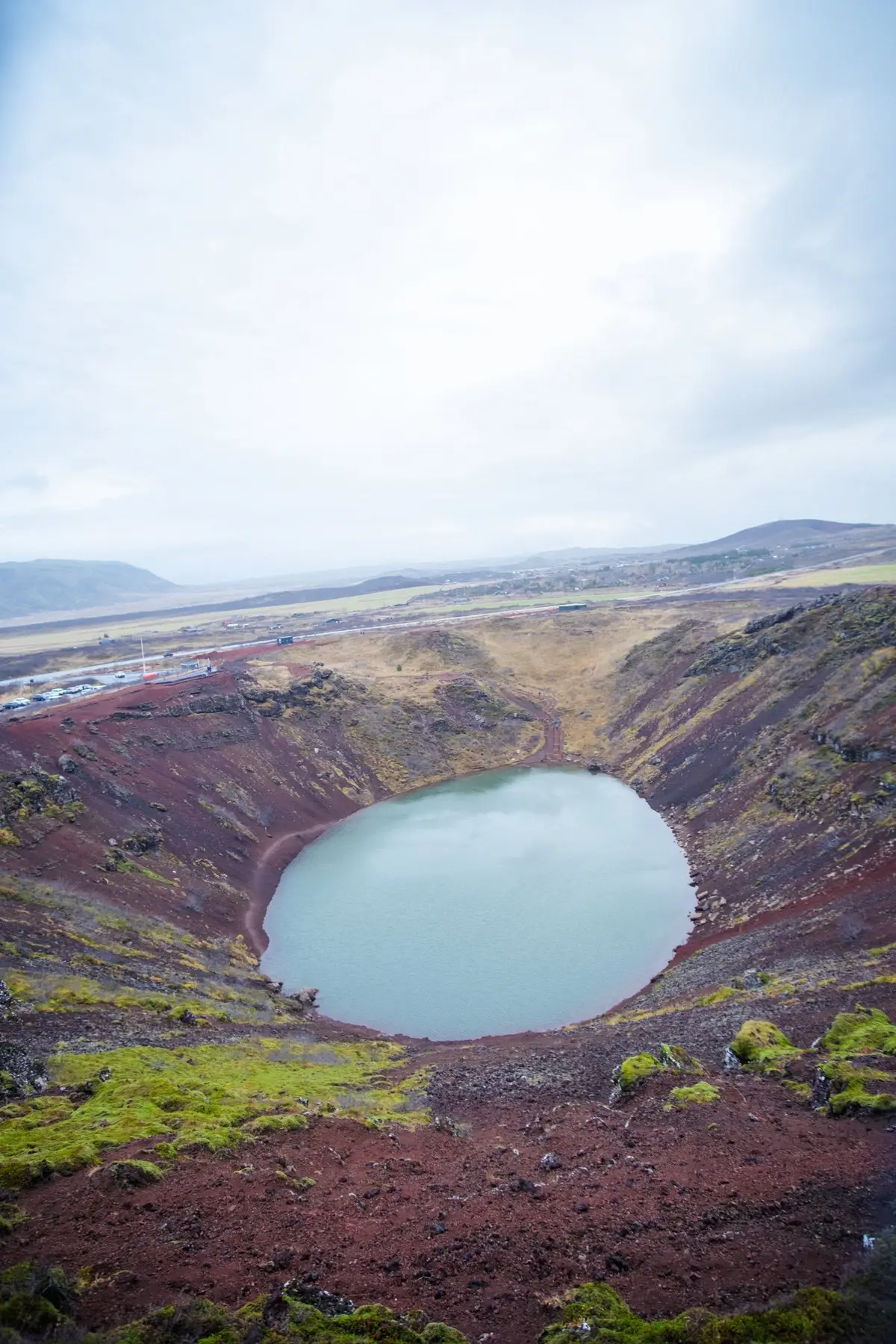
Kerið is on private land. In July 2013 a company of landowners began charging admission. In June 2014 the Environment Agency deemed it illegal: under the Nature Conservation Act anyone may cross uncultivated land, and charging requires an agreement between the state and the owners, which did not exist. The owners kept charging. In 2023 the crater was bought by Arctic Adventures, a tour company.
In November 2026 the ticket costs 700 krónur, with parking included. The official website says the crater is open "when the sun is shining", which in Iceland is a very poetic opening time.
Paying does not bother me: someone has to maintain the paths, the toilets, the ropes on the rim. What bothers me more is the question underneath, a relative of the one Sigríður fought over: who a piece of nature belongs to. Many Icelanders consider it a right to explore nature without impediment. Iceland Review writes that charging entry at private natural sites remains heavily disputed. Standing in front of a crater some six and a half thousand years old, I wonder what exactly is being bought.
Tomatoes under the lights
Along the loop there is also a story that goes the other way: people who brought visitors into their home. In 1995 Knútur Rafn Ármann and his wife Helena Hermundardóttir bought Friðheimar to combine their two passions, horses and growing things. They found two greenhouses and a large empty house; the greenhouses had been in use since 1946.
Between 2002 and 2006 they built a lit greenhouse, and since then they have grown tomatoes all year round under artificial light. Then they began letting passers-by in: horse shows, narrated in fourteen languages, a table among the plants, a shop, a wine bar in a converted greenhouse. In 2020 they built a 5,600 square metre greenhouse, which on its own more than doubled the tomatoes. In 1995 one person worked there; in 2025 more than a hundred.
Helena writes that everyone who works there should feel welcome, valued, part of the family. Coming from someone who started with an empty house, it does not sound to me like a brochure line.
"I know, Sveinki"
The last person on the loop, for me, is a bishop. Skálholt has been a bishop's seat since 1056. On 7 November 1550 Jón Arason was beheaded here, bishop of Hólar and poet, who had opposed the Lutheran Reformation and the religious changes imposed by Denmark. Two of his sons, Ari and Björn, were executed with him.
Before the blow, a priest named Sveinn said to him: "Líf er eftir þetta, herra!", there is a life after this one, sire. And Jón answered: "Veit ég það, Sveinki!", I know that, little Sveinn. It became an Icelandic saying, used when someone explains something obvious to you. A man about to die, with two sons condemned alongside him, finds the time to answer with an affectionate diminutive. Today a memorial marks the place of the execution, and the church you see was built between 1956 and 1963.
Who owns a waterfall
The loop takes a day, and it is easy: from Reykjavík to Gullfoss, by the Þingvellir road, the road administration's calculator counts 115 kilometres, all paved, and Visit Iceland notes that the loop can be driven all year, checking the roads on safetravel.is. In November 2026 parking at Þingvellir costs 1,000 krónur a day. In September 2026 the government put out for consultation a single fee for Þingvellir, Geysir and Gullfoss, 4,500 krónur a year for non-residents and 3,000 from November to May, which from May 2027 would replace the parking charges. It is still a proposal.
I think Sigríður would have recognised the question. She defended the waterfall against those who wanted to make money from it; today the state proposes to charge visitors from abroad to maintain paths and services around that same waterfall. They are not the same thing, and I do not know what she would have said. I know she died in Hafnarfjörður in 1957, aged 87, and that she is buried at Haukadalur.
When I do a loop like this I tend to count the stops. Since reading about her, I count one more: a three-kilometre trail, from a waterfall to a farm, that I have never seen in a Golden Circle itinerary.
You will find the voices of Þingvellir in the Law Rock and the eighteen women of the pool. On what happens to a place when it becomes famous, read Fjaðrárgljúfur and what happens when a place becomes content.
Questions and answers
How much do parking and entrance fees cost on the Golden Circle?
In November 2026 parking at Þingvellir costs 1,000 krónur a day for a car with up to five seats, at Geysir 1,080 krónur for eight hours, and entry to Kerið 700 krónur per person with parking included. For Gullfoss, check the signs on site.
Who was Sigríður Tómasdóttir?
She was the daughter of one of the owners of Gullfoss, born at Brattholt in 1871. For years she opposed using the waterfall to produce power; today a memorial above the falls remembers her.
sources
- Gullfoss, culture and history, Umhverfisstofnun (Environment Agency of Iceland)
- Sigríður Tómasdóttir, Wikipedia
- Gullfoss, Wikipedia
- Geysir, Wikipedia
- Strokkur, Wikipedia
- In Focus: The Cost of Iceland's Nature, Iceland Review, 7 October 2017, updated 19 June 2025
- Entrance Fee To Kerið Deemed Illegal, The Reykjavík Grapevine, 22 June 2014
- Kerið, article archive (Arctic Adventures Buys Kerið, 19 October 2023), The Reykjavík Grapevine
- Kerið, official website (Kerfélagið ehf.), accessed November 2026
- Kerið, Wikipedia
- About, Friðheimar
- Friðheimar, official website
- Skálholt, Wikipedia
- Jón Arason, Wikipedia
- Golden Circle (Iceland), Wikipedia
- The Golden Circle, Visit Iceland
- Vegalengdir, road distance calculator, Vegagerðin, accessed November 2026
- Geysir, parking payment, Parka, accessed November 2026
- Parking service, Þingvellir National Park, accessed November 2026
- Frumvarp um náttúru- og innviðagjald lagt fram í samráðsgátt (draft bill on a nature and infrastructure fee), Government of Iceland, 22 September 2026